
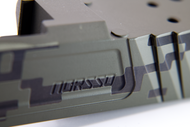
Laser Engraving vs. Laser Etching on Cerakoted & Factory Finished Slides
Posted by Stronghold Armament on May 16th 2026
Laser Engraving vs. Laser Etching on Cerakoted & Factory Finished Slides
In the world of premium slide customization, the terms laser engraving and laser etching are often used interchangeably — but they are fundamentally different processes with very different results. Understanding the distinction matters when choosing the right finish, durability level, and visual effect for your build.
Whether working with a raw steel slide, factory finished or a fully Cerakoted surface, the process selected directly impacts appearance, texture, longevity, and the overall craftsmanship of the final product.
What Is Laser Etching?
Laser etching is a surface-level marking process that alters only the outermost layer of the material or coating. On a Cerakoted slide, the laser discolors the Cerakote itself without significantly penetrating the coating or into the metal beneath it.
The result is a clean, refined graphic with minimal surface depth.
Characteristics of Laser Etching (AKA "Frosting")
- Minimal material removal
- Smooth surface finish
- Preserves underlying structural material
- Ideal for logos, patterns, serial-safe accents, and fine detail work
- Works exceptionally well on Cerakoted surfaces
- Typically does not require refinishing afterward
Because etching interacts primarily with the coating layer, it allows for high-contrast designs while maintaining the integrity of the original finish. This makes it a preferred option for topographic patterns, camouflage textures, branding marks, and intricate artwork where precision matters more than physical depth.
Best Applications
- Cerakoted slides
- Fine-detail graphics
- Frosted or tonal artwork
- Branding and logos
- Decorative textures and patterns
What Is Laser Engraving?
Laser engraving is a much deeper process that physically removes material from the slide itself. Instead of simply affecting the surface coating, engraving cuts into the steel or aluminum beneath the finish.
This creates permanent recessed geometry with visible and tactile depth.
Characteristics of Laser Engraving
- Significant material removal
- Physical depth you can feel
- Permanent metal alteration
- Requires post-processing on coated slides
- Ideal for deep logos, windows, index cuts, and structural-style artwork
On a raw slide, engraving exposes freshly cut metal immediately. On a Cerakoted slide, however, engraving cuts through the coating and into bare metal — meaning the slide typically needs to be refinished or recoated afterward for corrosion protection and a uniform appearance.
Best Applications
- Raw slides
- Deep logos or lettering
- Machined-style aesthetics
- Aggressive textures
- Multi-stage custom builds
- Projects requiring aggressive serrations
Cerakoted Slides: Why the Process Matters
When working with Cerakoted components, the distinction becomes even more important.
Etching on Cerakote
Etching allows artwork to be added after coating without requiring the slide to be recoated. The laser selectively removes portions of the Cerakote to expose contrast beneath the surface while preserving the finish.
This process is efficient, clean, and ideal for customers wanting refined customization without fully reworking the coating system.
Engraving on Cerakote or Factory Finish
Engraving penetrates through the Cerakote or Factory Finish and into the metal itself. Because raw metal becomes exposed during the process, the component typically requires:
- Surface preparation
- Recoating or refinishing
- Final curing and inspection
For this reason, deep engraving is usually performed before Cerakote in professional build sequencing combining the process into one cohessive project.
Choosing the Right Process
The right option depends on the intended purpose of the build.
Choose Laser Etching If You Want:
- Crisp visual contrast
- Fine detail work
- Minimal surface disruption
- Artwork on an already Cerakoted slide
- Faster turnaround without refinishing
Choose Laser Engraving If You Want:
- True depth and texture
- Maximum permanence
- Structural-style aesthetics
- Deep-cut logos or patterns
- A fully custom refinishing workflow
Precision Beyond Appearance
At the highest level, laser work is more than decoration — it is part of the engineering and identity of the build itself. Proper laser processing requires calibrated power settings, material understanding, coating knowledge, and disciplined workflow sequencing to achieve consistent results without compromising form, fit, or function.
The difference between etching and engraving is not simply how a design looks — it is how deeply the craftsmanship is built into the component itself.